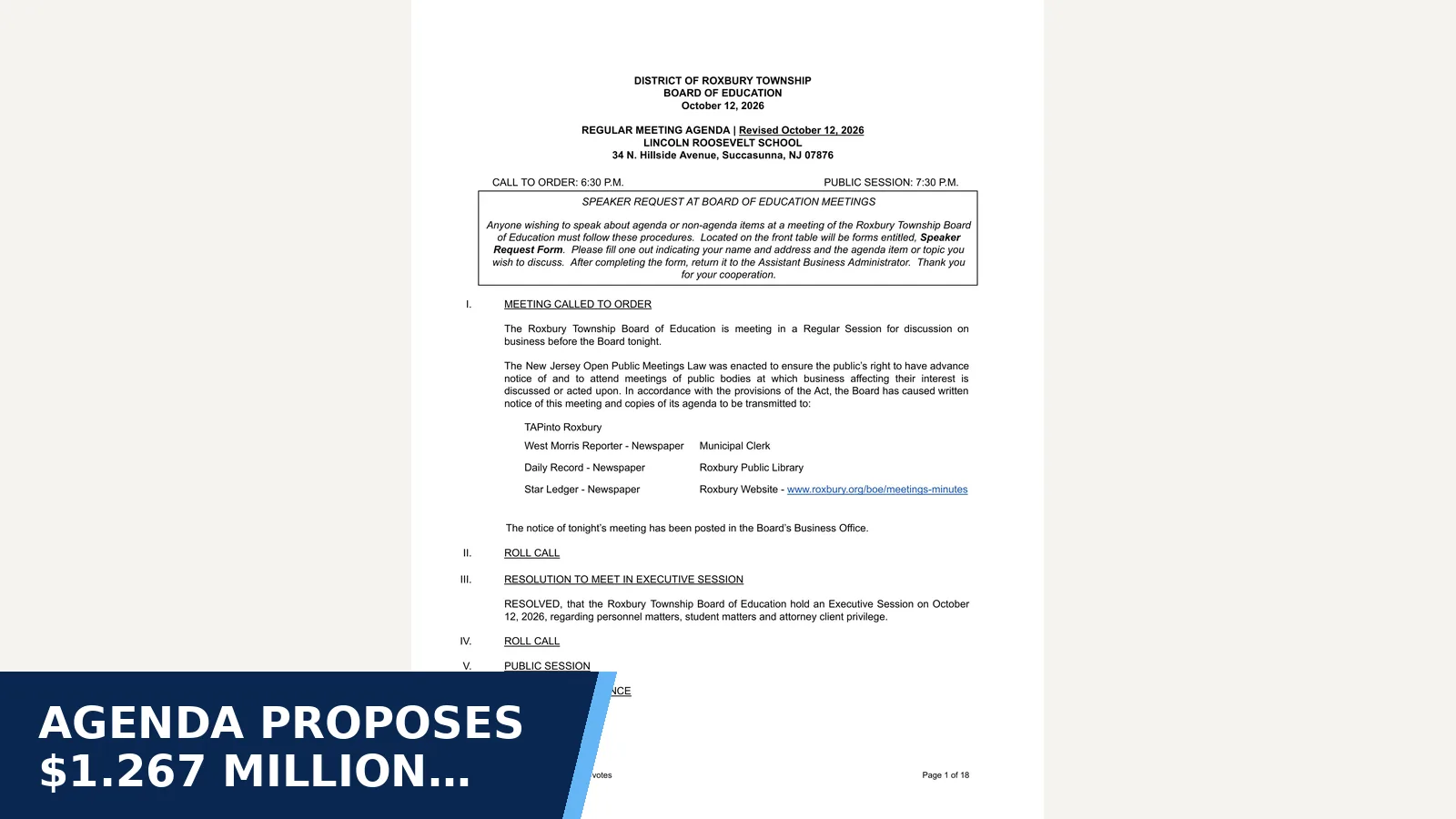
The Oct. 12 agenda proposes awarding the Lincoln Roosevelt School Classroom Alteration project to Northeastern Interior Services for $1,267,000, funded through Capital Reserve.
We bring transparency to school decisions nationwide by tracking school board meetings, district documents, and public data. We use AI tools, rigorously evaluated for accuracy, to search for risks.
The policy desk
What’s moving in phones
The debate over phones, screens and the school day.
No recent stories in this edition. Explore the latest reporting below.
The policy desk
What’s moving in AI
How artificial intelligence is changing classrooms and school rules.
No recent stories in this edition. Explore the latest reporting below.
The policy desk
What’s moving in student voice
Students speaking up, organizing and helping shape their schools.
No recent stories in this edition. Explore the latest reporting below.
Newark Public Schools opened New Media High School on September 8 with more than 100 ninth-graders enrolled. The new career-focused high school will prepare students for content creation, video media production, and entertainment management; it will initially operate at Bard High School Early College while the former Dayton Street Elementary site undergoes major repairs.
Bayonne has been preparing a bond referendum that would build a new school on the St. Andrews site and pay for facility improvements across the district. At the August 25, 2026 meeting a trustee said the board had been asked by the superintendent and administration in February 2026 to move ahead with that plan, that the work had been done and hundreds of thousands of dollars of taxpayer money spent on it, and that trustees had been told at a committee meeting the week before that someone had stopped the referendum. The trustee asked publicly who had the authority to stop it and whether the reason was educational and financial or political, and asked the board to put the question to Bayonne voters. The board president replied that she had not stopped anything, had not politicised it, and would like this board to bring the referendum to fruition before the term ends. The superintendent said putting the architect and legal counsel out to RFP would slow the process and that costs could be discussed once those were appointed.
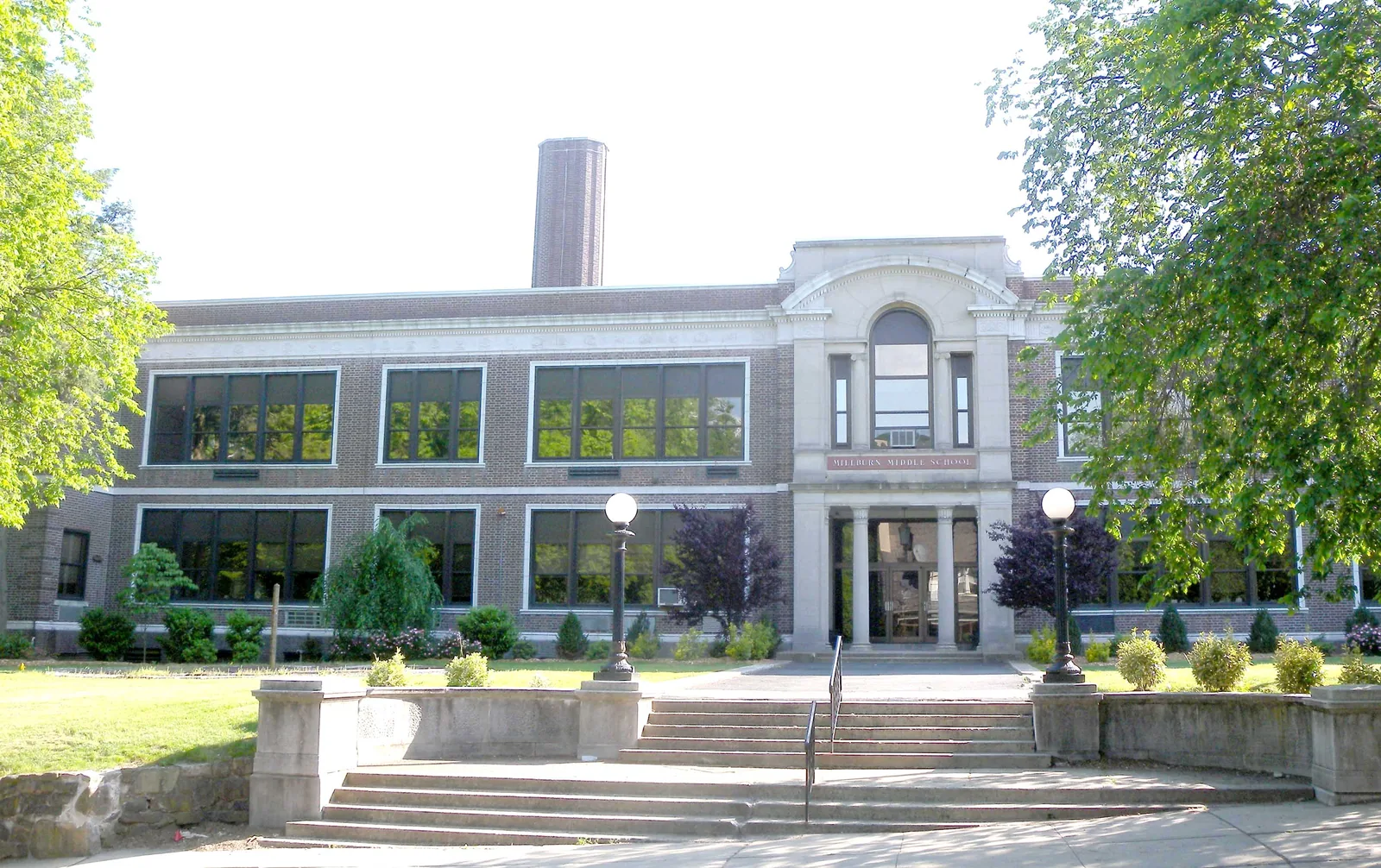
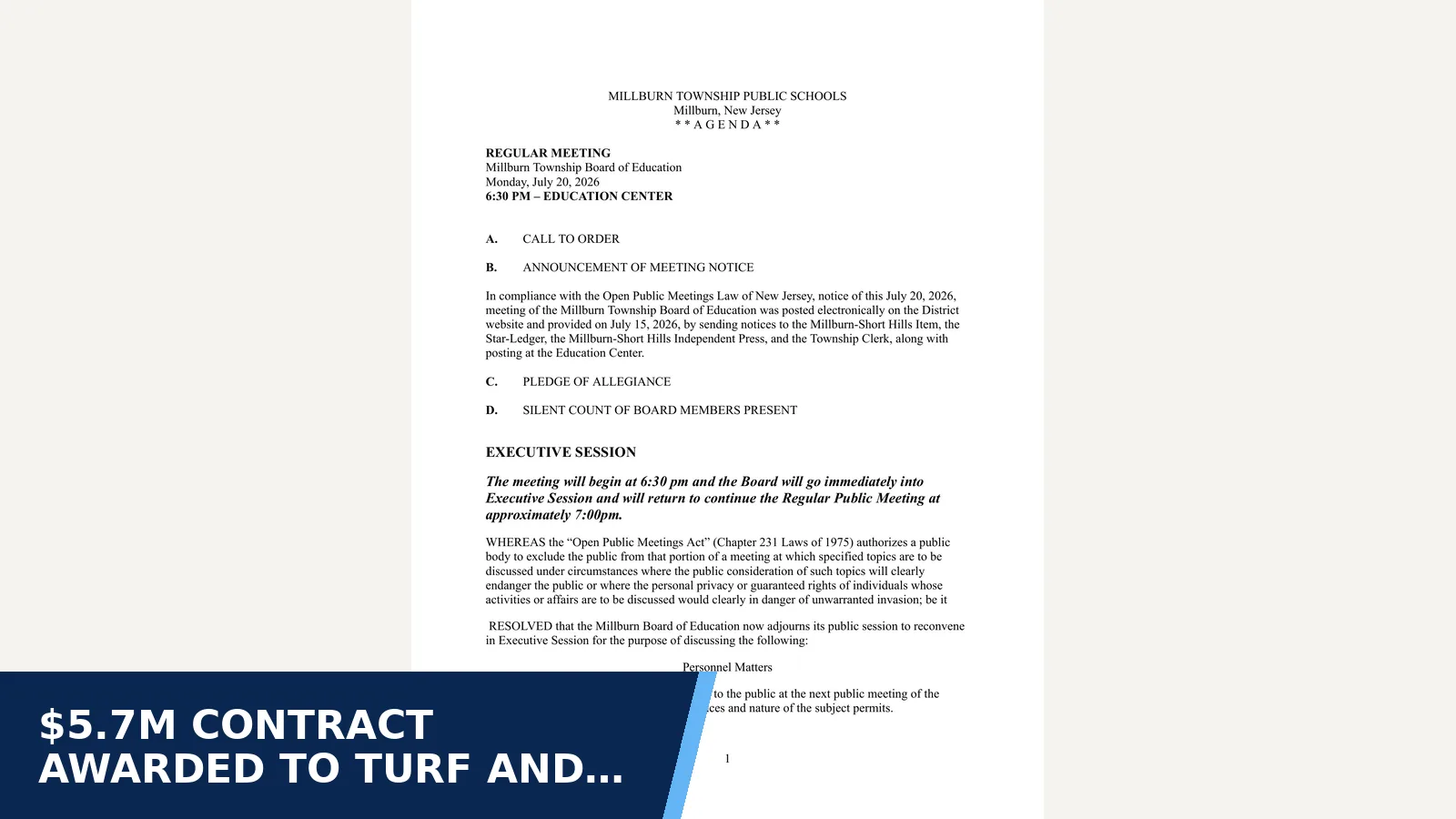
The Board approved a $5,666,283 contract to convert Millburn High School’s natural-turf field to synthetic turf and add athletic-field lighting. The award went to Thomas & Sons Builders LLC, subject to required project documentation.
The pre-referendum presentation to the board in August 2026 sets out the number driving everything else: 1,116 projected unhoused pupils, derived from the demographic report prepared in November 2025. That study had already shown Livingston High School 373.5 pupils above its capacity of 1,661, rising to 541 above by 2030-31, with 1,062 new housing units expected to add about 195 pupils. The response is a grade reconfiguration of every level of the district plus a central bus depot, and the same presentation drops the April 2027 vote date that the June version had carried. In the meantime the board approved open-campus lunch for high school juniors and seniors for 2026-27, which is one of the few things that can relieve a building at lunchtime without construction.
The district is building a pre-kindergarten classroom addition at Littleton Elementary School, called Phase 2, with a budget adjusted during the year from $3,796,714 to $5,888,000 and funded through a capital reserve transfer. Construction ran through summer 2026. The building has been operating on a temporary certificate of occupancy that had to be extended, because the district is waiting for the township to file a federal application for an antenna the township is requiring the board to install.
The board approved agenda items for an EBOE Mitchell Building HVAC-upgrades capital-improvement project associated with Dwyer Academy and a separate capital-improvement project for Terence C. Reilly School No. 7.
Collingswood Middle School and Collingswood High School were merged into a single secondary campus for 2026-27, which the superintendent described as one school, one campus, one culture. Management is now split into grade bands of 6-8, 9-10 and 11-12, each with a director of instruction, a school climate officer and an administrative assistant, in place of a principal and assistant principals at each school; a 6-12 special education supervisor and a 6-12 athletics and activities director were restored and the counselling and wellness centres were combined. The superintendent told the board plainly that the merger is a response to falling enrolment rather than a way to increase it, and that projected high school enrolment drops from 750 to 613 in a year. Because the high school receives federal Title I money and the middle school does not, the district said it would keep operating two school codes for at least another year.
In approved August 18 minutes, the Board adopted an Energy Savings Plan, approved HESP Solar to install and maintain photovoltaic panels, and authorized the plan to proceed through cost-neutral refunding bonds. The September 15 agenda schedules a public hearing and resolution for issuing up to $10.5 million in Energy Savings Obligation Refunding School Bonds; that issuance is presented as proposed, not as a completed sale.
On July 30, 2026 the board voted to pay for its building repair programme through a county improvement authority instead of putting a bond question on the ballot. A motion to hold the decision back failed, and the board then shelved the alternative resolution that would have started a public referendum. One member said he did not believe the law lets a district bypass voters.
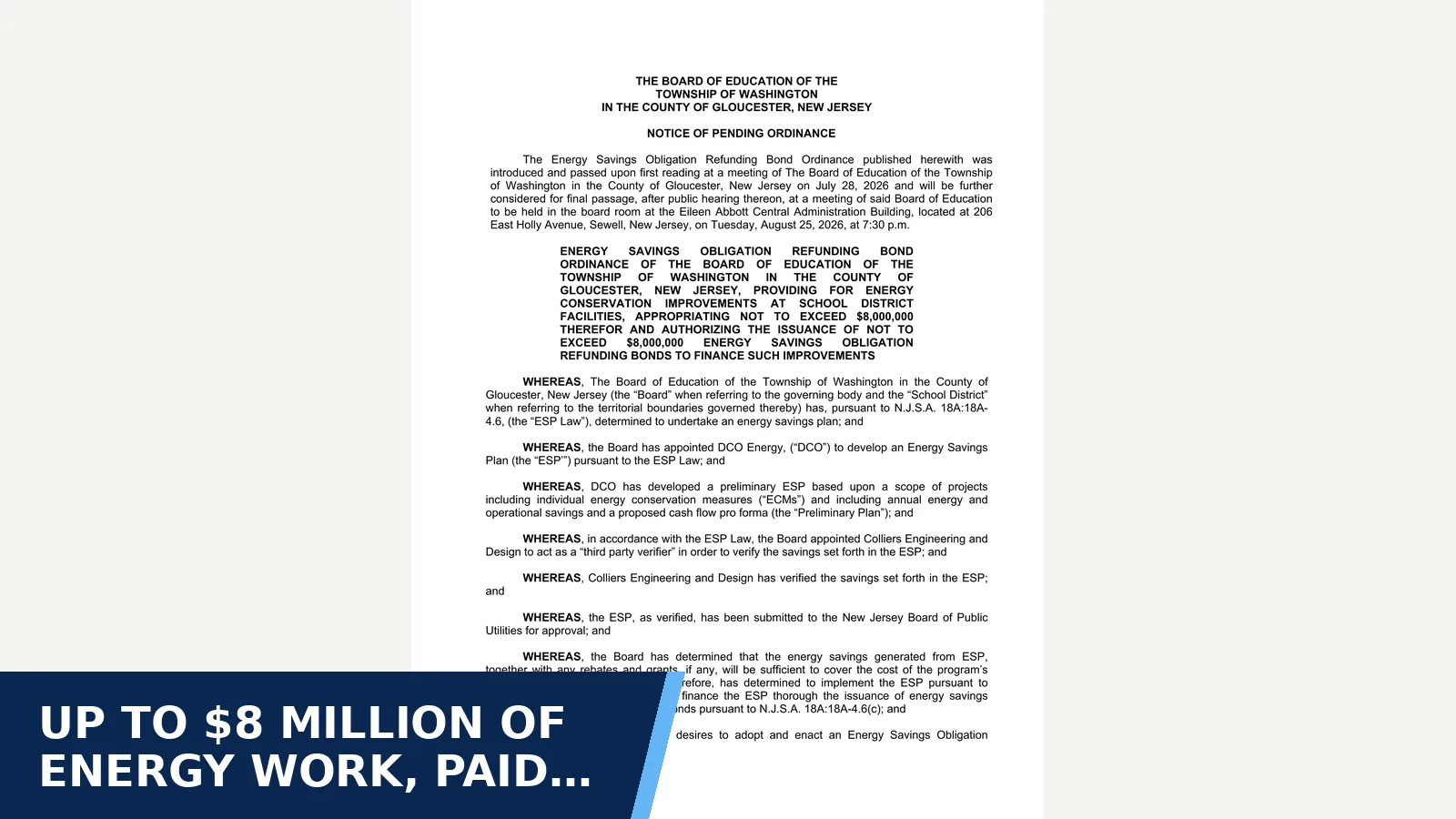
The board introduced an ordinance on July 28, 2026 authorising up to $8,000,000 of energy savings obligation refunding bonds to pay for energy conservation measures in district buildings, with a public hearing and final passage set for August 25, 2026. Under New Jersey's Energy Savings Plan law the work has to pay for itself: the savings it generates, plus any rebates and grants, must cover the cost. DCO Energy developed the plan, Colliers Engineering and Design verified the savings as an independent third party, and the plan went to the New Jersey Board of Public Utilities for approval.
The board and Millburn Township jointly proposed converting two multi-purpose fields plus Miller Field at Millburn High School from grass to artificial turf and adding lighting, first presented in November 2025 at a preliminary cost of about $7.5 million. After a shared-services agreement with the Township, a $192,500 design contract, and public objections over environmental impact and the lack of a townwide referendum on the project, the board awarded the actual construction contract on July 20, 2026 to Thomas & Sons Builders LLC for $5,666,283 to convert the turf and add field lighting.
At the June 29, 2026 meeting a community organiser gave the board the district's own lead testing history: 2022 results showed outlets in 25 schools above the action level of 15 parts per billion, some above 100 and some above 1,000, while 2025 results showed four schools still exceeding it, among them a bottle-filling station at Carol Robbins Elementary. The board authorised an application to the state's school lead filter programme for $19,719.48 and a water infrastructure grant application. The statement of assurance the district must file about lead was adopted on August 31, 2026, though it directs submission on or before June 30, 2026, and it concedes that notifications were required for outlets exceeding the action level.
In April 2026 the board awarded construction of a new transportation complex to H&S Construction and Mechanical at up to $12,950,000, drawing the money from capital reserve. On June 29 it rescinded that award and gave the work to Newport Construction Corporation at up to $13,037,700, revising the reserve withdrawal upward to match. The resolution explains the reversal only as necessary 'due to administrative review and/or corrective action' and names nothing further; the minutes record no discussion of what the review found.
On June 25, 2026 the facilities committee set out the work Brick is lining up beyond the heating and cooling contracts already running: a comprehensive facilities assessment of the whole district, the Osbornville Elementary kitchen addition, continued air-conditioning work at Warren H. Wolf and Herbertsville early childhood centres and at Midstreams and Osbornville elementary schools, ADA chair lifts at Brick Township High School, and replacement of the fuel tanks and pumps at the transportation depot. The committee is also weighing whether this adds up to a future referendum, though no question, cost or election date has been published.
Livingston's demographer projects 1,116 pupils with nowhere to sit. On June 9, 2026 the architect presented two options and on June 16 the five board members unanimously agreed, by consensus rather than resolution, to proceed with option one: a total project cost of $227,974,175, made up of $175,364,750 of construction plus $52,609,425 of other project costs, before any state aid. It would put a pre-kindergarten centre at Mount Pleasant Elementary, take elementary schools to grade five, move grade six into Heritage Middle School, and add high school athletic fields, a central bus depot, renovations at Monmouth Court and security and technology upgrades; the two largest lines are $65.6 million at Heritage Middle School and $79.3 million at the high school. The district's financial adviser put the cost to a household at $1,129.94 a year on the average home assessed at $729,272 over 25 years at 4.15 percent, or $1,015.02 over 30 years, with no state aid assumed. A vote date of April 20, 2027 appeared in the June material but had been dropped from the August version, and the board's goals for 2026-27 say only that it will choose a date during this school year or early in the next.
Westfield voters approved $225,807,242 of school bonds at a school district election held on April 15, 2025, on a proposal the board adopted on March 25, 2025. On June 16, 2026 the board adopted the resolution fixing the form and details of the first permanent issue, $125,807,000 of school bonds maturing in annual instalments from 2028, and providing for their sale. Before that the district had been carrying the work on $25.3 million of one-year bond anticipation notes. The programme covers all nine Westfield schools and runs from 2026 to 2028: full-day kindergarten additions and renovations at Franklin, Jefferson, McKinley, Tamaques, Wilson and Washington elementary schools; electric service replacement districtwide; air-conditioning and mechanical replacements; locker room and small-group-instruction work at Edison and Roosevelt intermediate schools; and a Westfield High School package covering the media centre, auditorium, locker renovations, the child study team and wood shop areas, and the drive loop. FKA Architects is architect of record and Legacy Construction Management is owner's representative. The first large construction contract, the McKinley Elementary School additions and alterations project, was awarded to M&M Construction Company of Cranford on August 25, 2026 at $14,175,000.
On June 11, 2026 the board approved 2026-2027 capital outlay of $4,418,975, of which $3,216,257 goes to districtwide HVAC replacement. The superintendent told the board that HVAC problems were happening across the district and needed to be addressed comprehensively. During the year the district also handled emergency HVAC repairs at Central Middle School, a transformer at Parsippany Hills High School, a Mount Tabor roof replacement, and a Central Middle School rooftop unit that carried about $83,000 in rebates, leaving a net cost of roughly $75,000.
The Board approved a September 15, 2026 special election on $158,394,556 in renovations at all ten district sites and additions at Sussex Avenue Elementary, Frelinghuysen Middle, and Morristown High schools.