District proposes new elementary grading scale and weights
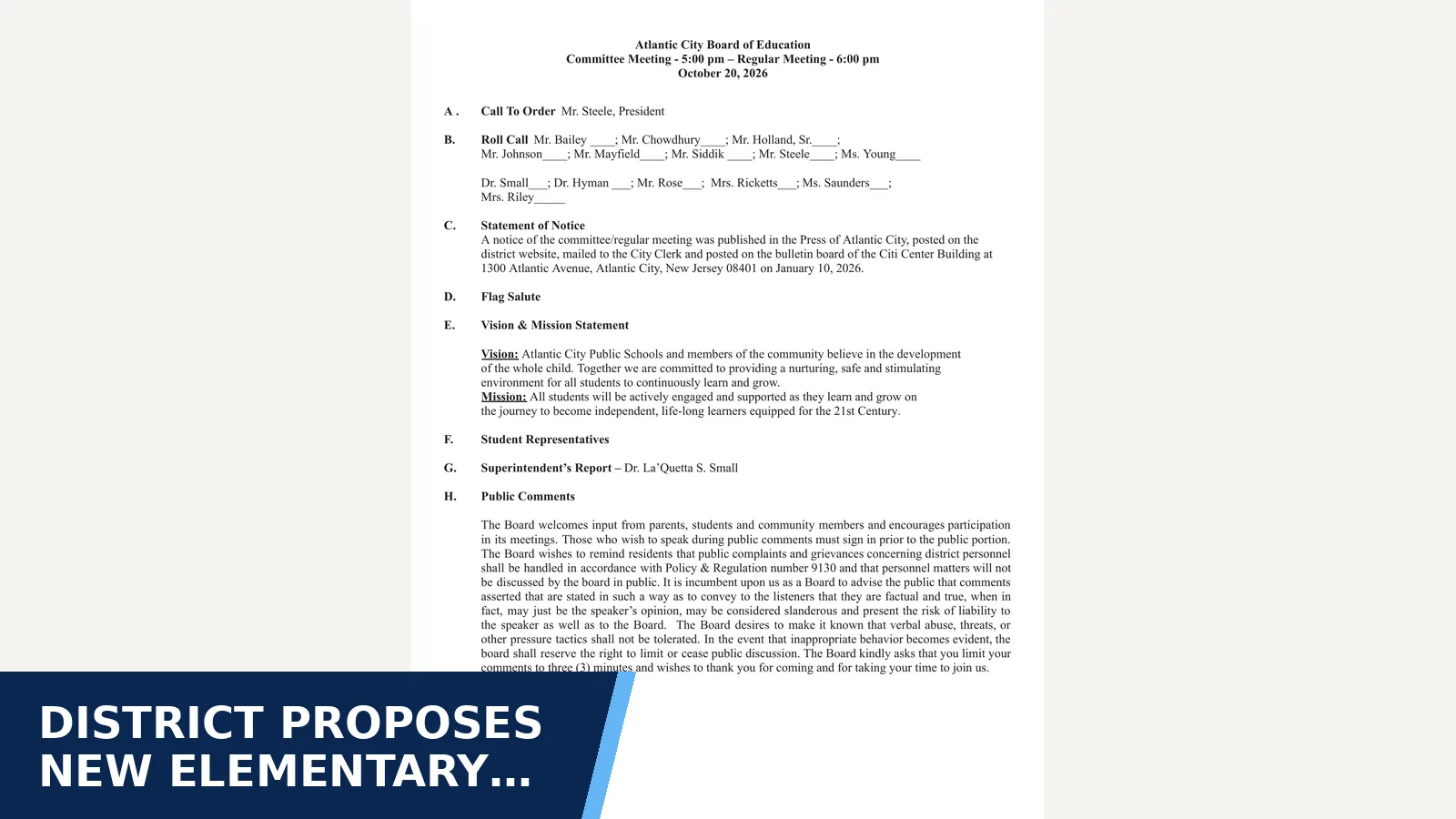
The Oct. 20 agenda proposes replacing the previously approved elementary grading scale and weights for the 2026–27 school year.
Read the full storyThe Oct. 20 agenda proposes replacing the previously approved elementary grading scale and weights for the 2026–27 school year.
Read the full storyWe bring transparency to school decisions nationwide by tracking school board meetings, district documents, and public data. We use AI tools, rigorously evaluated for accuracy, to search for risks.

The policy desk
The debate over phones, screens and the school day.

The policy desk
How artificial intelligence is changing classrooms and school rules.

The policy desk
Students speaking up, organizing and helping shape their schools.
The news desk
Three of the pages a resident would use to judge the district are years out of date. The quality single accountability review page carries a district performance review for 2020-21 and a statement of assurance for 2017-18, and nothing since. The business office's financial and audit page carries audited reports up to 2021-22, so the 2024-25 audit on this page came from the state's own filing rather than from the district. The school performance page carries only the state's standard letter telling families where the reports live, with no summary of West New York's own results. The district's comprehensive equity plan for 2025-2028 is posted, but as an image-only scan.
Livingston Board of Education School District
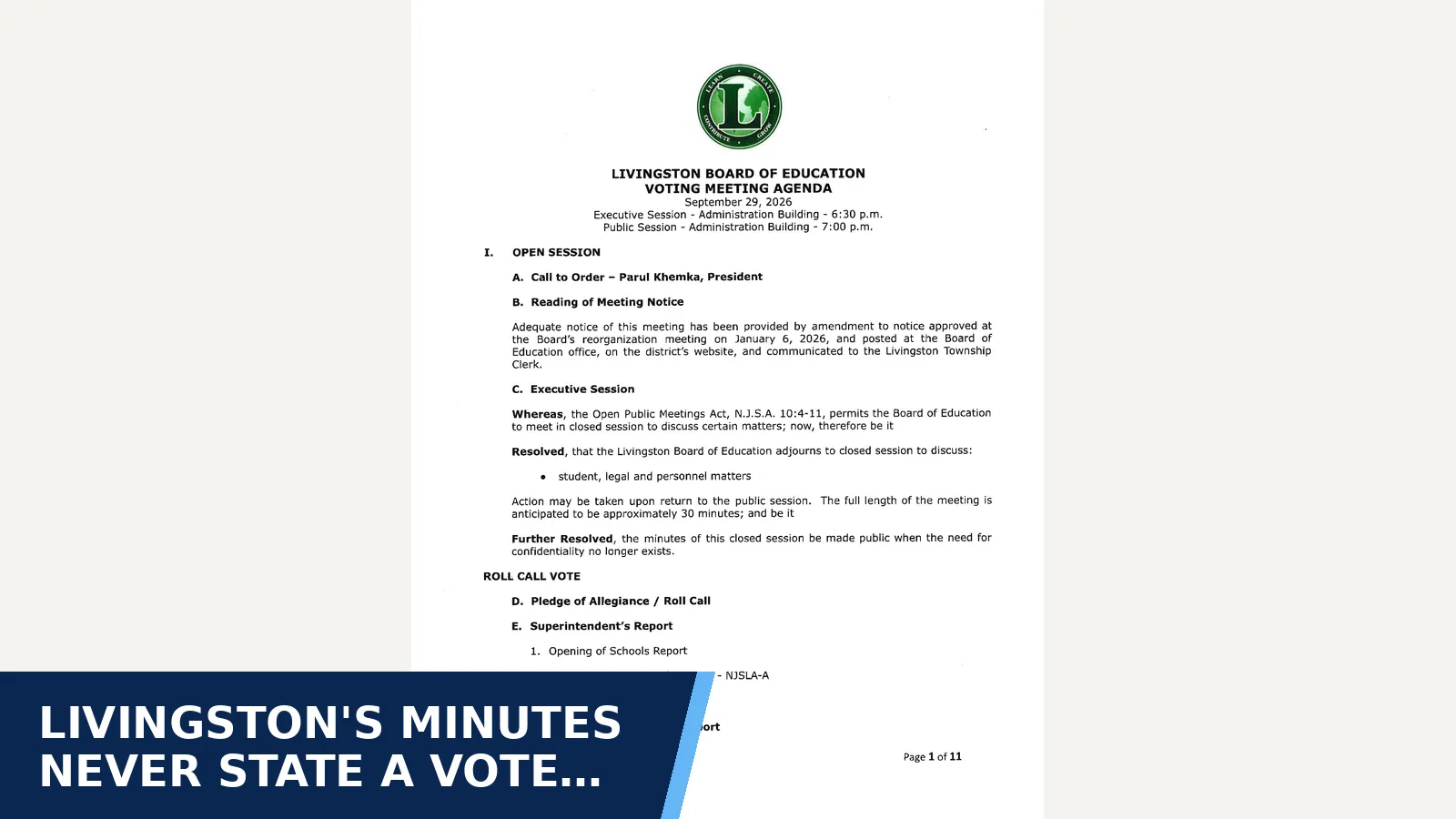
Every roll call in the district's approved minutes for the year is written as ayes by name with none against - Chirls, Cohen, Gong, Khemka, Yelisevich, the five voting members - and no numeric tally appears anywhere. That is enough to identify how each member voted on the main business, which many districts fail to do. The gaps are elsewhere: motions to enter closed session and to adjourn are recorded as 'vote all in favor' with no names, even where the agenda called for a roll call, which happened at both closed-session-only meetings and again in May; and the substance of most business reaches the minutes only as attachment references, so bill lists, stipend rosters, transfers and most personnel tables are named but not reproduced. Anti-bullying reports are accepted at nearly every meeting with no incident counts stated.
Matawan-Aberdeen Regional School District
Two policies set the rules families live with. Policy 5516.02 requires internet-enabled devices to be off and stored in a backpack or locker from bell to bell, out of sight in classrooms, hallways, cafeterias and bathrooms, and collected outright during assessments; using a phone to bully or harass, even away from school, can cost a pupil the right to bring one at all. It was adopted in August 2024 and revised twice in 2026, in August and again in September. Policy 2365 covers pupils' use of generative artificial intelligence in schoolwork and requires the district to run an AI Plan naming which schools and year groups may permit it, when a teacher may authorise it, an approved-platform list, annual parental consent, and a list of prohibited uses including passing off generated work as one's own.
Collingswood Public School District
After Garfield Elementary closed and its 113 children were spread across four schools, a parent told the board on September 28, 2026 that his first grader is in a class of 28. The district's own budget papers had warned of an impact on class size from the redistribution, and two of the four receiving schools were already at or above their state-assessed capacity. Administrators told the board that New Jersey caps class size only in pre-kindergarten, kindergarten in Title I schools and special education, so every other grade has no legal limit; the district's own policy aims to stay under 25 in kindergarten and grade 1 and allows a range up to 30 above that, and a class of 30 with one teacher and no aide is possible within it. A district employee told the board in April that a recent district update on class-size maximums was best described as the limit does not exist. Administrators said the district remains in full compliance with its own class-size policy.
Pemberton Township School District
New Jersey's expanded income eligibility raised the limits again for 2026-27: a household of two can earn $48,474 and still qualify for free school meals, against a federal limit of $40,034, and depending on household size the state limits run $15,000 to $21,000 above the federal ones. Because the application is a federal form it shows only the federal figures, so families can be turned down federally and still qualify through the state. Applications moved to the forms tab of the Genesis parent portal, and reduced-price students pay nothing because the state covers the difference.
Brick Township Public School District
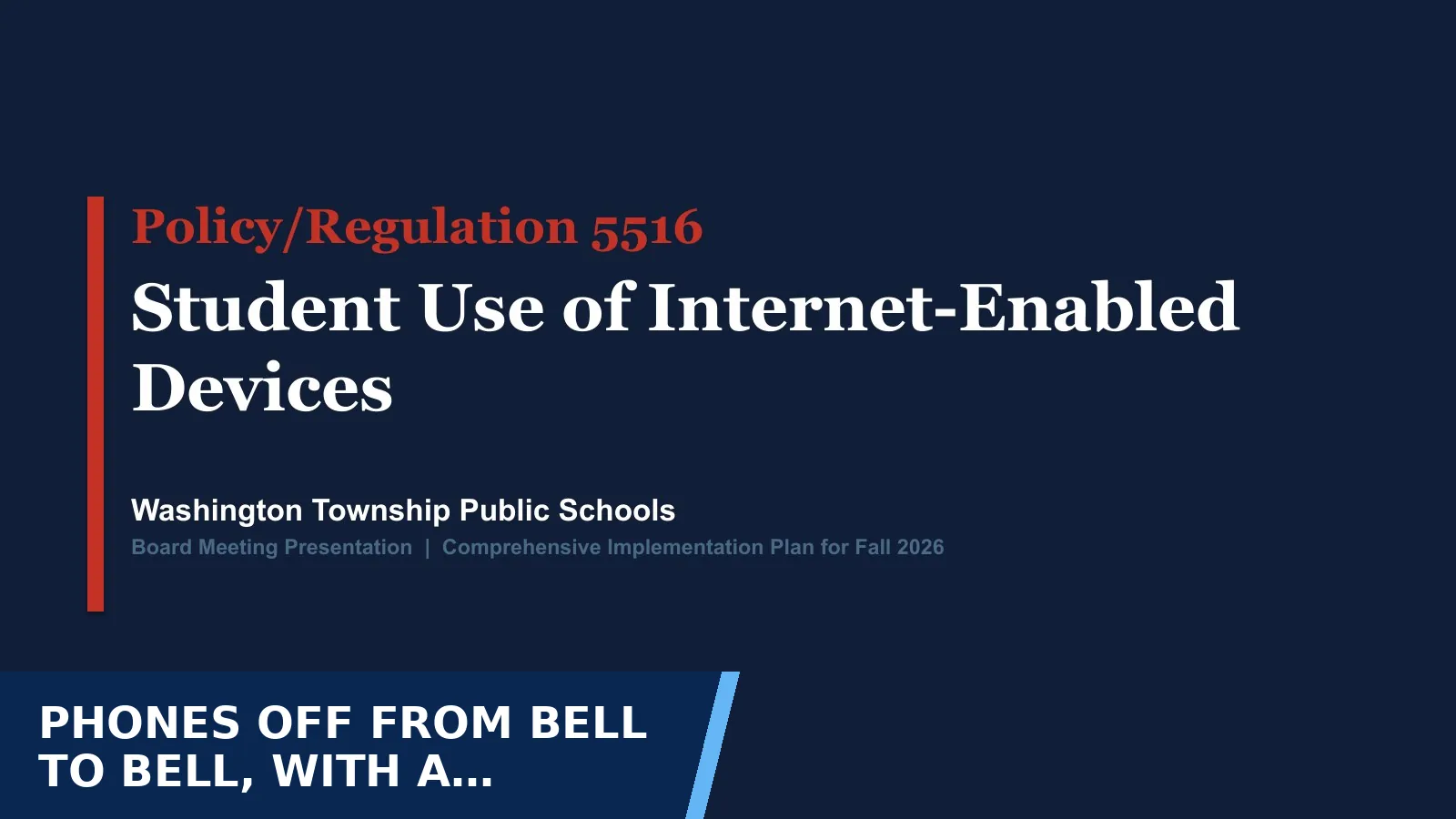
Brick Township's Policy 5516, Student Use of Internet-Enabled Devices, was last edited in September 2026 and is up for second-reading approval on the September 24, 2026 agenda together with its regulation. It prohibits students from using an internet-enabled device on school grounds during the school day, following New Jersey's bell-to-bell law and the state's January 2026 guidance. An internet-enabled device covers smartphones, tablets, smartwatches and smart glasses, but not a district-issued device used for schoolwork.
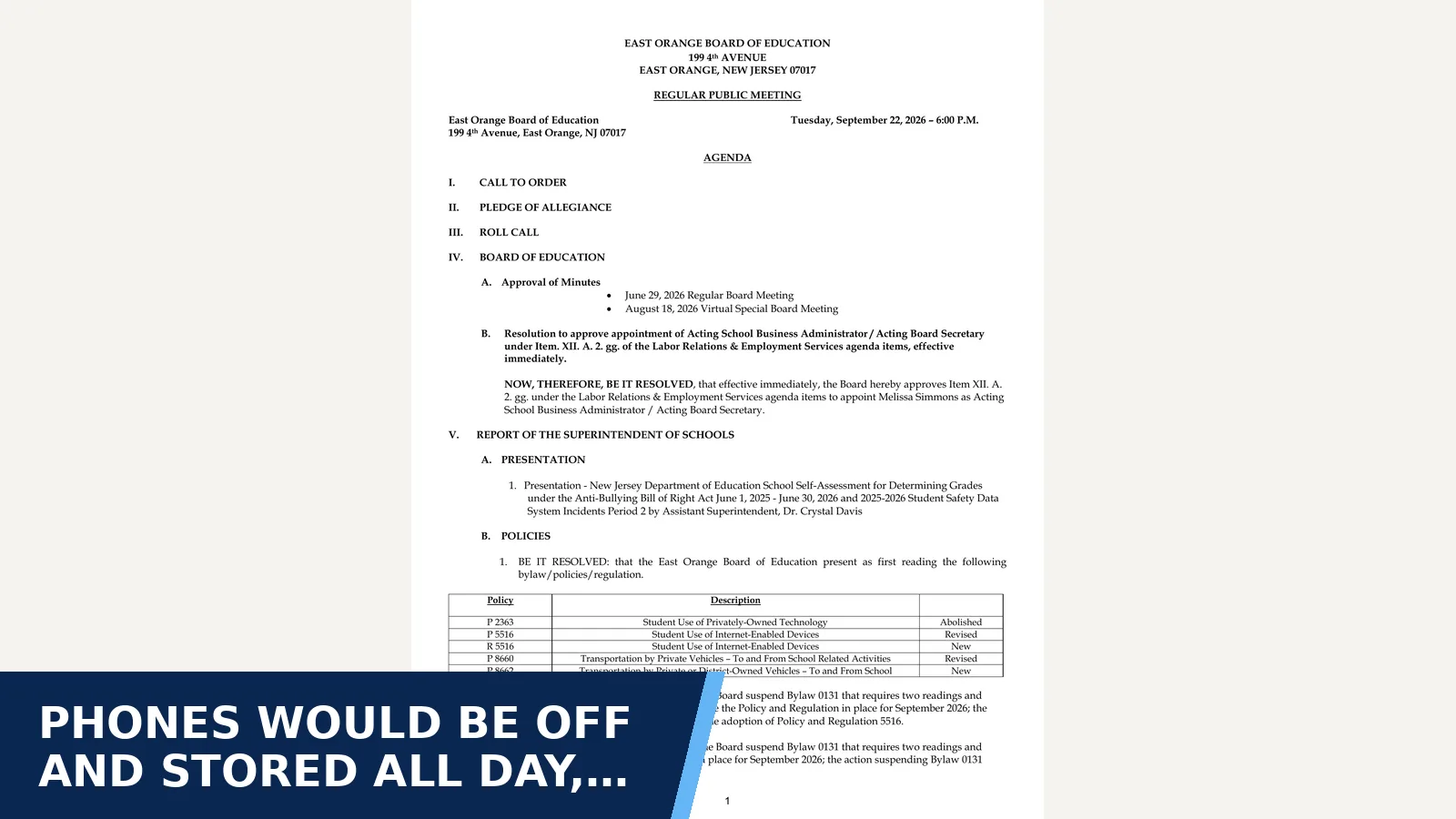
On the September 22, 2026 agenda the board is asked to replace its old device rules with a revised Policy 5516 and a new Regulation 5516, Student Use of Internet-Enabled Devices. Students in every grade would be barred from using an internet-enabled device on school grounds during the school day; grades 6 through 12 would store phones during the day, including in locked pouches handed back at dismissal; and students in kindergarten through grade 5 could not use even a basic non-internet phone. Classroom time must be entirely free of personal devices and teachers may not build personal phones into lessons.
Clifton High School has implemented new cell-phone expectations for the 2026-27 school year, including prohibiting student phone use in gym class and reinforcing limits on phone use in hallways.
Montclair Public School District
The Board is scheduled to take a first reading of Policy 2365, Acceptable Use of Generative Artificial Intelligence (AI), which would govern AI use by all students, teachers, administrators and professional staff in any district setting or context.
Montclair Public School District
The September 16 agenda proposes a districtwide AI policy that would allow student use only under a district plan and a teacher's instructions.
West Windsor-Plainsboro Regional School District
WW-P's current AI guidance permits specified district-approved tools, while unlicensed ChatGPT and Claude cannot be required for assignments. The default for in-class assignments is Red: AI use is not allowed unless a teacher provides different instructions.
Freehold Regional High School District
Freehold Regional's posted Policy 5516 prohibits student use of internet-enabled devices during the school day and requires devices to be turned off and secured in assigned lockers on entry.
Roxbury Township School District
Roxbury High School began using a new schedule in the 2026–27 school year that substantially increases annual instructional time. It also opens instructional centers during common lunch, giving students a new opportunity for supplemental academic support.
Ridgewood Public School District
In the district's June 2026 community survey, more than two-thirds of 1,155 parent respondents said they want less screen time in the classroom, and staff responses raised concerns about cheating with artificial intelligence. Ridgewood's rule on student devices, Policy 2363, was adopted on September 10, 2012 and leaves phone and device use to each teacher's permission. The district has no published artificial-intelligence policy, and its acceptable-use policy does not mention AI. In March 2026 a parent told the board there is no consistent grade-level Chromebook policy, that a request for usage data was refused, and that students defeated new YouTube restrictions within hours.
In September 2026 the district issued families a notice implementing New Jersey's bell-to-bell restriction on student phone use. The board policy that actually governs the subject, Policy 5516 on electronic communication and recording devices, was created in June 2008, last edited in April 2016 and adopted on 13 April 2016, and has not been re-adopted since. Its prohibition is already broad - no such device may be turned on or used on school grounds during the school day or during any curricular or school-sponsored activity, except in an emergency, outside the school day or with a supervising staff member's permission - but the devices it enumerates are cameras, pagers and beepers, personal digital assistants, two-way radios and portable fax machines, its only statutory citation is the 1990s paging-device statute, and it contains no storage or pouch requirement, no tiered discipline, and no medical or individual-education-plan accommodation language.
Bloomfield Township School District
Bloomfield adopted a bell-to-bell device policy on September 8, 2026. Policy 5516 stops students using an internet-enabled device on school grounds during the school day, defines bell-to-bell as the opening bell to the dismissal bell, and says a device brought to school must stay off and may have to be locked in a district storage system that only the student's own password opens. The rule also covers the school bus and school-sponsored events, and it counts smartwatches and smart glasses as well as phones. Classroom time must be entirely free of personal devices, and teachers may not build them into lessons. Before this version the policy was adopted in December 2018 and revised in February 2025.
Atlantic City High School says its 2026-27 cellphone-free policy limits nonacademic use of cellphones, smartwatches, earbuds and other internet-enabled devices during the school day.
Washington Township School District (Gloucester County)
From autumn 2026 students from pre-kindergarten through grade 12 may not use personal phones, tablets, smartwatches or smart glasses anywhere on school grounds during the school day. Storage differs by level: elementary devices off and in a backpack or cubby, middle school devices off and locked in a school locker, high school devices off, password-protected and in a backpack - explicitly not in a locker. Earbuds and headphones are barred, and so are basic flip phones. Phones are allowed on the bus and before and after the school day. Middle school breaches run through a five-step ladder from a warning to detentions, Saturday school and internal suspension; the high school has a ten-step ladder ending in two-day internal suspensions with a mandatory parent meeting and daily device check-in at the main office.
For the 2026-27 school year, all three of Belleville's student handbooks carry the same cell phone rule, and each states it was adopted to meet a New Jersey law requiring every public school to have and enforce a policy on student cell phones and other personal electronic communication devices during the school day. The handbooks say the point is to remove distractions, protect instructional time and encourage face-to-face interaction, that compliance is mandatory for all students, and that the full text sits in board Policy and Regulation 5516. The elementary handbook extends the rule to smart watches.
Pemberton Township School District
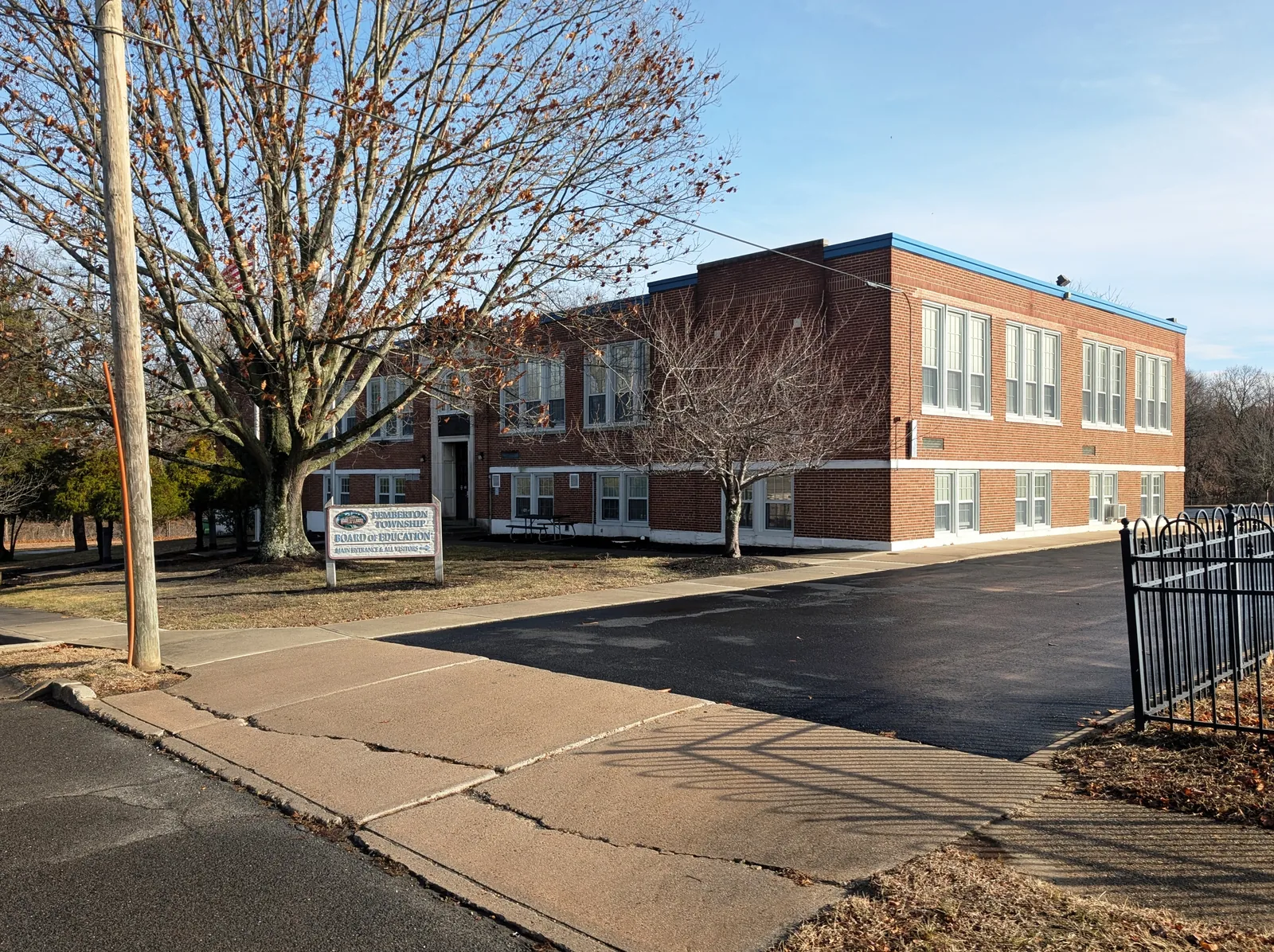
In his August 31, 2026 back-to-school message the superintendent said that in line with New Jersey law students will not be permitted to use cell phones at any point in the school day, and that while the rule has been in place for some years the district would focus on stricter enforcement in 2026-27 across all nine schools. Families were asked to talk to their children about it before school started.
Pemberton Township School District
The state's performance report puts Pemberton's chronic absenteeism at 23.2% in 2023-24 - almost one student in four absent for a tenth of the year or more - against a statewide average of 14.9%. The district has missed the state accountability target in each of the last three reported years, though the rate is coming down from 30.1% in 2021-22 and 24.3% in 2022-23. The superintendent has made it a stated priority in three separate video messages and reported in June 2026 that it continued to fall.
Trenton Public School District
Among the teaching and learning resolutions approved on August 31, 2026 is a districtwide renewal of the HIBster bullying case-management package with its two additional modules, recorded with a cost not to exceed 'TBD' and an accounting code of 'TBD'. HIBster is the platform through which harassment, intimidation and bullying reports are filed and tracked, and the board had approved it a year earlier at $42,000. This sits alongside a standing gap in the record: the bullying report is approved on every regular consent agenda in the year and its contents appear in no posted document, so the only bullying figures available come from occasional presentations.
Closer to home
Explore the national edition and nearby communities.